
Select an artwork and listen to the audio guide.
No matches found! Please enter another keyword and try again.
1. Matsura Sayohime
Goyo Hirata
1. Matsura Sayohime
Goyo Hirata
Sayohime Matsura is a legendary figure who features in the Manyoshu, a collection of Japanese poetry dating back to the 8th century.
She is said to have lived in the Matsuura district of Hizen Province, in present-day Saga Prefecture.
As told by the Manyoshu, when her lover Otomo no Satehiko departs on a military expedition to Korea, Sayohime climbs a high mountain, takes a white scarf from her shoulders and waves it in an outpouring of grief.
The mountain was afterwards remembered as the “scarf-waving peak.”
This doll captures the moment Sayohime waves her scarf, overcome with sorrow at her lover’s departure.
The gestures and simplified form of the model convey her feelings with great power.
Goyo Hirata was a leading maker of realistic clothed dolls.
Following the Second World War, however, he began incorporating fabric into his carved-wood dolls in a style known as “kimekomi,” and simplified the doll’s overall form.

2. Bisque doll(Triste or Long-face)
Emile Jumeau
2. Bisque doll(Triste or Long-face)
Emile Jumeau
Bisque dolls are dolls with faces made from unglazed porcelain.
Large quantities of child bisque dolls with movable limbs were made in France and Germany in the second half of the 19th century, and Jumeau was one of the leading French doll makers from this time.
Emile Jumeau, the entrepreneurial son of the company’s founder, created numerous outstanding models.
The doll before you is a type known as “triste” or “long-face” due to its sad expression—its face was designed by the French sculptor Albert-Ernest Carrier-Belleuse, whom Emile Jumeau had commissioned to come up with the ideal child’s face.
This doll wears a blue dress, and a lace hat and boots.
Her blond hair is made using mohair—hair from the Angora goat, and her glass eyes contain exquisitely crafted blue irises.
Her unique facial features and translucent skin are hallmarks of the best Jumeau dolls.
3. Alice
Kuniyoshi Kaneko
3. Alice
Kuniyoshi Kaneko
Alice portrays a pale-skinned girl wearing a red dress with a white collar, a white ribbon in her hair; she holds a white rabbit, and the pair are set against a blue sky.
From the title, we can infer that these are the Alice and White Rabbit that appear in Lewis Carol’s Alice in Wonderland.
In the story, Alice is an extremely curious child, who chases a White Rabbit down a rabbit hole into a mysterious kingdom; in the painting, Alice holds the rabbit firmly, as if to prevent the rabbit from escaping into this other realm.
In 1974, Kuniyoshi Kaneko was commissioned by the Italian company Olivetti to create pictures for an illustrated edition of Alice in Wonderland, and the artist created a series of pencil drawings faithful to Lewis Carol’s original text.
In this more abstract painting, Kaneko has captured the essence of Alice, a child who moves freely through an illogical kingdom of games.

4. Girl
Simon Yotsuya
4. Girl
Simon Yotsuya
Shimon Yotsuya considered the Western dolls he made to be cheerful.
However, he had the opportunity to display his works alongside the dolls of foreign artists at a doll exhibition in Paris in 2004, and he realized that his dolls were extremely quiet and uniquely Japanese.
These qualities stem from a determination to eliminate, as far as possible, his own intentionality from the creation process, instead focusing on creating noiseless and odorless works.
Yotsuya’s dolls appeared ornate, but they were in fact quiet and uniquely Japanese.
This doll is ball-jointed, and is made from a plaster mold using papier-mâché.
In this gallery, there is in fact another doll taken from the same mold.
This doll wears a white dress, while the other wears a red dress; there are also slight differences in their silhouettes and hairstyles, and in the way their eyebrows and lips are painted.
The impressions they create are extremely different.

5. Girl
Simon Yotsuya
5. Girl
Simon Yotsuya
This ball-jointed doll shows a young girl wearing a red dress.
Shimon Yotsuya’s ball-jointed dolls are created using a traditional papier‐mâché technique: first, he makes a model out of clay; he then creates a plaster mold based on this model; next, he layers papier‐mâché into the mold, and removes it after it has dried.
This dried papier‐mâché model is coated with a plant-based clay called toso; a further layer of gofun—a calcium-white powder made from clam shells—is applied; the model is then polished.
Finally, ball-joints are inserted between the various body parts, and the doll is assembled.
In this gallery, there is a second doll, wearing a white dress, made from the same mold.
Since the two dolls have been finished in a different manner, the impressions conveyed by their facial features also differ.
6. Sisters
Kuniyoshi Kaneko
6. Sisters
Kuniyoshi Kaneko
Kuniyoshi Kaneko held a solo exhibition at the Naviglio Gallery in Milan in 1971.
The previous year, the owner of the Naviglio Gallery had visited the Aoki Gallery in Ginza, where he had seen and taken a liking to Kaneko’s paintings and promised the artist a one-man show.
The works Kaneko exhibited at the show were purchased by the art director of the Italian Olivetti company, and this led to Olivetti commissioning Kaneko to create pictures for an illustrated edition of Alice in Wonderland.
Sisters was one of the pictures shown at Kaneko’s solo exhibition in Milan.
Backed only by a red curtain and blue sky, two girls—partially clothed in corsets—sit on a chaise longue; their bodies exude movement, but their faces are expressionless.
The influence of the Belgian surrealist Paul Delvaux, whom Kaneko had a great interest in at that time, can perhaps be detected in this painting.
The expressionless sisters stare into the distance just like the silent characters who populate Delvaux’s fantastical, fictional worlds.
Kaneko said: “In an endless reverie permeated by poetic imagination and mystery, there lurks the smell of death and the end of the world.”
His preoccupation with the end of the world is evident in this picture, too.

7. Eve of future and past 10
Simon Yotsuya
7. Eve of future and past 10
Simon Yotsuya
Shimon Yotsuya exhibited this doll at his first-ever one-man show in 1973, entitled “Eves of the Future and Past.”
The title of the doll itself was taken from an essay that Tatsuhiko Shibusawa, a scholar of French literature, contributed to the exhibition.
Shibusawa is thought to have been inspired by a science fiction novella named The Eve of the Future, authored by the 19th-century French writer Auguste Villiers de l’Isle-Adam, in which the inventor Thomas Edison creates a beautiful android for his despairing young friend, Lord Ewald.
Eves of the Future and Past No.10 is one of twelve dolls that Yotsuya made for his show.
It portrays Yotsuya himself when he played a female role for the Jokyo Gekijo, an avant-garde theater troupe founded in the 1960s.
The doll is highly idiosyncratic, its face made-up with oil paint, its body lacquered, and its pubic hairs emphasized.
The work appears to reflect a desire Yotsuya later expressed “to create not just cute or beautiful dolls, but much more sinister dolls.”

8. Indiscreet doll 8
Simon Yotsuya
8. Indiscreet doll 8
Simon Yotsuya
In 1968, Shimon Yotsuya appeared in a play entitled Yui Shosetsu, performed by the avant-garde theater troupe, Jokyo Gekijo.
With his painted face and intense phrases uttered ad lib, he proved a popular actor.
A Doll without Modesty No.8 is one of a series of dolls Yotsuya created in the 1970s, depicting his time as an actor.
The dolls’ lips are colored bright red, it is dressed in black, lace underwear, and adorned with decorative accessories—it reflects Yotsuya’s thespian intensity and, as the title suggests, it is very much “a doll without modesty.”
The doll’s highly unusual pose—with its upper and lower bodies rotated 180 degrees—creates a sense of strangeness that points to the influence of the French surrealist dollmaker Pierre Molinier.
Molinier, too, was an artist that was introduced to Japan by the scholar of French literature, Tatsuhiko Shibusawa.

9. Mechanical boy 2
Simon Yotsuya
9. Mechanical boy 2
Simon Yotsuya
This doll of a young boy is both ball-jointed and clockwork.
Simon Yotsuya created each part of this doll using traditional papier-mâché techniques; he then inserted ball-joints between the body parts, and finally assembled the whole.
Its hands and eyes have been connected to the doll’s base using piano strings, and by winding the key to the right of the base, they can be moved via clockwork.
So that viewers can see the mechanism in action, Yotsuya has made the front upper body removable.
Yotsuya is thought to have been inspired to create this clockwork doll by the automated dolls and fairground attractions that appear in the works of Tatsuhiko Shibusawa.
He entrusted the creation of the clockwork mechanism to mechanical engineer Hiroshi Araki.
This is one of three clockwork dolls that Yotsuya displayed at a 1980 solo exhibition.

10. Girl
Simon Yotsuya
10. Girl
Simon Yotsuya
Simon Yotsuya specialized in making ball-jointed dolls.
In the 1970s, he created the “Eve of Future and Past” series of maliciously erotic dolls; in the 1980s, however, while retaining this eroticism, his dolls became prettier and kinder in appearance.
This ball-jointed doll of a young girl is clothed only in a bustier, socks, and a pair of sandals.
Her lips are colored a pale pink, and her ears pierced.
Yotsuya strove to create “timeless and odorless” dolls—this is evident in the girl’s emotionless appearance, her black pupils looking quietly forward.

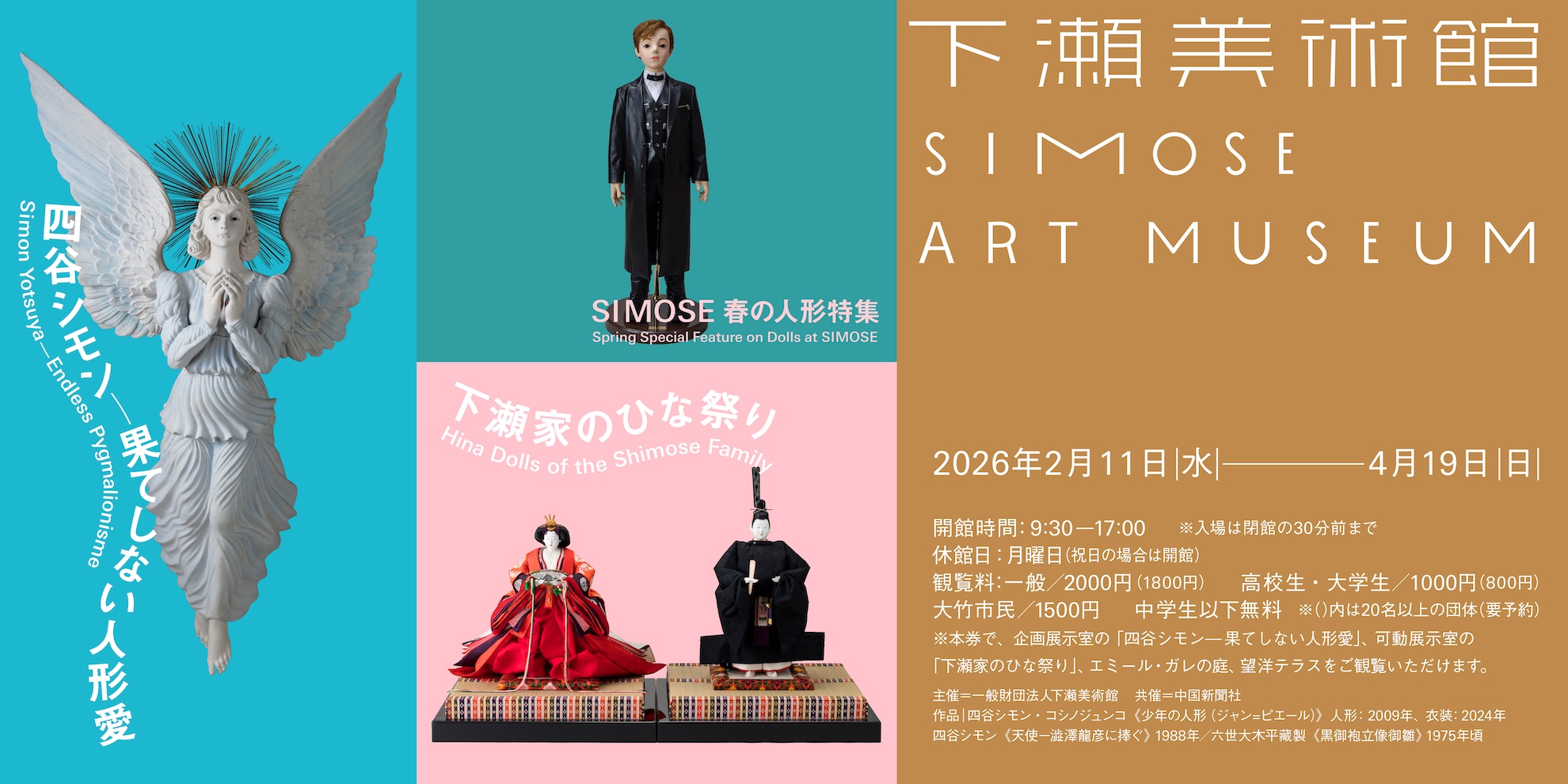
11. Angel Dedicated to Tatsuhiko Shibusawa
Simon Yotsuya
11. Angel Dedicated to Tatsuhiko Shibusawa
Simon Yotsuya
Simon Yotsuya idolized the French scholar Tatsuhiko Shibusawa; it was Shibusawa who had introduced him to Hans Bellmer’s ball-jointed dolls, and this encounter had a profound influence on Yotsuya.
When Shibusawa died in 1987, Yotsuya was inconsolably sad.
To escape from the depths of his sorrow, he devoted himself to creating a series of angel dolls that he had planned with Shibusawa while he was still alive.
But what was the significance of these angels?
When contemplating what happens to humans in death, Yotsuya concluded that the invisible souls of humans continue to exist—and that these souls could best be represented in physical form as angels.
The piece before you is the largest of his angel dolls and, unusually for Yotsuya, is not ball-jointed.
Its skin and hair are white, while its wings and clothing are a pale blue.
The angel hovers in the air, and is crowned with a golden halo.

12. Gosho doll, shakkyo
Heizo Oki VII
12. Gosho doll, shakkyo
Heizo Oki VII
This piece, entitled “Shakkyo,” is based on “Goshoningyo Mitateshakkyo,” a doll that forms part of the collection of the Kyoto National Museum.
“Shakkyo”—meaning “stone bridge”—is a Noh play that features a lion dance.
In the Tang dynasty, Monk Jakujo travels from Japan to China; there, beside a stone bridge that leads to Mt. Seiryo and the Pure Land of Bodhisattva Monju, he encounters a child.
The child teaches Jakujo about the origins and the history of the stone bridge: that the bridge is dangerous and cannot be crossed, that on the other side of the bridge lies the Pure Land of Bodhisattva Monju, and that, in front of the bridge, a miracle will surely occur.
Before long, there appears a lion—a beast from the Pure Land of Bodhisattva Monju—and, in a frenzy, the lion begins to play with blooming peony flowers.
On the Noh stage, the stone bridge is suggested by a tatami mat covered with peonies.
In this work, however, the lion is depicted holding red and white bouquets of peonies and, instead of wearing a lion mouth, the mouth is placed upon the actor’s head.
The red crêped haragake apron and sleeveless odenchi kimono are decorated with peonies and butterflies, showing the doll’s connection to the play.

13. Hongurui doll, Gosechinomai dance
Heizo Oki VII
13. Hongurui doll, Gosechinomai dance
Heizo Oki VII
“Gosechinomai” is a centuries-old female dance accompanied by Japanese court music.
According to legend, the dance dates back to the 7th century.
The Emperor Tenmu was playing the koto in the Yoshino region of Nara Prefecture, when a heavenly maiden descended before him, and turned the sleeve of her celestial robe over five times while dancing.
The Shoku Nihongi, an imperially commissioned historical text, relates that the Empress Koken personally danced the gosechinomai in 743, while she was still a princess; the dance is then thought to have become an established part of the Niiname-sai and Daijo-sai festival celebrations in the 9th century, during the reign of the Emperor Saga.
However, it ceased to be performed during the Sengoku period in the 15th century, and was revived during the Edo period in the middle of the 18th century.
Due to its three-hundred-year hiatus, both the dance itself and the costumes worn by the dancers had to be created anew.
It was not performed during the Daijo-sai festival during the reign of the Emperor Meiji, resurrected during the Daijo-sai festival in the reign of the Emperor Taisho, and has since continued to be performed through the Showa, Heisei, and Reiwa periods.
In this work, the dancer wears a karaginu over her uwagi—both forms of traditional kimono—and in her right hand she holds a wooden fan.
In her hair is a decorative golden flower called a “kokoroba,” and white, thread-like hair ornaments known as “hikageito.”

14. Prince of Lan Ling
Heizo Oki VII
14. Prince of Lan Ling
Heizo Oki VII
This work features a costumed doll and large drums from “The Prince of Lan Ling,” a piece of classical Japanese song and dance.
Set in 6th century China, the song tells of Gao Changgong, better known as the Prince of Lan Ling of the Northern Qi.
According to legend, he possessed great physical beauty and, fearing that this would affect the morale of his soldiers, he took to wearing a mask of the dragon in battle.
The song and dance are often performed at Itsukushima Shrine in Hiroshima Prefecture, and the costumes worn by the performers are extremely distinctive.
The Prince of Lan Ling wears a sleeveless ryoto poncho fringed with red and white hair, a gold obi belt adorned with red cords, and a form of long traditional Japanese clothing known as sashinuki hakama.
His gold mask has a hanging jaw and is adorned with a small dragon on top.
Behind the Prince of Lan Ling stand two large flame-decorated kaendaiko drums.
They serve to accentuate the imposing figure of the Prince of Lan Ling, who holds a drumstick as he dances.

15. Noh doll, “Chikubushima”
Heizo Oki VII
15. Noh doll, “Chikubushima”
Heizo Oki VII
Noh dolls often depict characters from auspicious plays such as “Takasago,” “Tsurukame,” and “Chikubushima.”
In particular, the protagonists from the Chikubushima play, Ryujin and Benzaiten, are favored for their flamboyance and often used for Gosho dolls, Hongurui dolls, and Oboko dolls.
The three figures here are “Hongurui” dolls—child dolls that are three heads tall—based on characters from the Chikubushima play.
Ryujin stands in the center, with a vassal and Benzaiten—who play supporting roles in the play—to his right and left respectively.
The story of Chikubushima is as follows: A vassal of the Emperor Daigo goes to pray at a shrine on Chikubushima Island in Lake Biwa.
There, he encounters Ryujin, the dragon king of the sea, and Benzaiten, patron goddess of music.
Benzaiten dances for the vassal; Ryujin offers him precious gems, and pledges to enlighten the masses, and ensure peace across the land.
Here, the red-haired Ryujin wears a dragon crown, is equipped with a hammer-shaped cane, and holds a kaendama—a jewel enveloped in fire.
Benzaiten has a black kurotare wig and a heavenly crown, and wears the clothing of a celestial maiden.
The vassal, meanwhile, wears the courtly eboshi hat; historically, this would have been a large black eboshi, but the doll-maker has used gold leaf
for decorative effect.

16. Hina doll
Heizo Oki VI
16. Hina doll
Heizo Oki VI
Historically, there have been two forms of hina dolls: tachi-bina, or standing hina dolls; and dairi-bina, or seated hina dolls.
Hina dolls grew in popularity around the middle of the 17th century, as part of the Hinamatsuri festival that takes place every March, and both standing and seated hina dolls were put on display.
These two dolls can be further categorized as yusoku-bina—a type of hina doll created in Kyoto by the Takakura family, who were students of court attire.
The male hina doll is dressed in full court attire; he wears formal “uenohakama” legwear and a black robe, a crown upon his head, socks known as “shitouzu,” and he holds a “shaku”—or flat scepter—in his right hand.
The majority of the standing hina dolls created by the Maruhei Oki Doll Shop were clothed in ochre-colored robes; it is said that the sixth-generation master only made three figures robed in black, including the figure before you.
Its clothing is a blend of historical court attire and the splendor of the imaginary.
The female hina doll is also dressed in full court attire, namely the “karaginumo” worn in the Imperial court.
Karaginumo was more commonly known as “junihitoe,” meaning “twelve layers,” and comprised, in order, the following items: kosode, uchibakama, hitoe, itsutsuginu, uchiginu, uwagi, karaginu, itsutsuginu, uchiginu, uwagi, karaginu, and mo.
Her hair is tied in the osuberakashi style, and adorned with a yui hairband and saishi hairpin.
Her make-up incorporates the double-eyebrows known as “nijumayu.”

17. Hongurui doll, Court lady with a Japanese spaniel
Heizo Oki VII
17. Hongurui doll, Court lady with a Japanese spaniel
Heizo Oki VII
The child in this work is a “kanjo,” or court lady.
Her traditional hakama clothing is scarlet, but it was customary for children to wear dark purple hakama.
And while a kanjo never wears an embroidered kosode, her kosode is embroidered with cherry blossoms and other designs.
Here, the doll-maker Heizo Oki appears to have mixed fact and fiction, prioritizing decorativeness over historical fidelity.
The dog is a Japanese spaniel, a traditional breed of dog that was imported from China during the Nara.
Later, in the Edo period, these small, expensive dogs were frequently kept in court circles and women’s quarters of Edo castle.
This pair of dolls, entitled “Court lady leading a Japanese spaniel,” was often used to celebrate the first Hina festival after a baby’s birth, up to the start of the Second World War.
The attractiveness of the girl’s scarlet hakama and the dog’s white fur meant the pair of dolls were frequently included in hina doll displays.
Before the war, Japanese spaniel dolls used to be flocked, with silk hairs implanted onto the surface of the doll; after the war, however, a lack of craftsmen forced even Heizo Oki to start carving them out of wood.
The doll here is one such example.

18. Five court ladies
Heizo Oki VII
18. Five court ladies
Heizo Oki VII
Normally, a hina doll display would feature three court ladies; here, however, there are five court ladies, making for a lively scene.
Court ladies would never have worn embroidered kosode garments; in this work, however, they are wearing gorgeous kosode embroidered with phoenixes and cherry blossoms, tie-dyed in the hitta-shibori style.
Strict adherence to historical forms of dress can result in a lack of ornateness, and so the doll-maker has here chosen to blend fact and fiction.
Heizo Oki categorizes court ladies into three types, according to how the straps of the formal hakama trousers they wear are tied: “tasuki,” in which the straps of the hakama are tucked up with a tasuki cloth; “musubi,” in which the straps of the hakama are tied up at the side of the dress; and “uchigi,” in which the straps of the hakama are tied at the side, and an uchigi robe is worn over the top.
The court ladies in this work are dressed in the musubi style.
Together, the five dolls create a humorous scene: the court maidens on the outside left and right—both holding containers of sake—are young wakaonna girls; the court maidens on the inner left and right—both holding ornate shimadai stands—are ofuku, ladies with plump round faces and small, round noses; the court maiden in the center has an aged face.
Each of the dolls holds an object used during auspicious occasions—such as noshi origami containing dried abalone, kumokawarake earthenware bowls—and helps imbue the hina doll
display with a sense of positivity.

19. Ichimatsu doll
Heizo Oki VII
19. Ichimatsu doll
Heizo Oki VII
“Ichimatsu ningyo,” or Ichimatsu dolls, take their name from Ichimatsu Sanokawa, a renowned mid-18th century kabuki actor.
Ichimatsu won fame in the Keihan region as a wakashugata—a kabuki actor who specializes in the roles of young adolescents; he then moved to Edo, where his star rose further.
Nigao ningyo—dolls resembling real people—modeled after Ichimatsu were made for his fans, and came to be known by a variety of names: Ichimatsu ningyo, after the actor himself; daki ningyo, or hugging dolls, as they could be hugged; and mitsuore ningyo, or three-fold dolls, as they were typically made to be folded in three places—at the waist, knees, and ankles, although they could also be folded at the arms.
This doll features bobbed okappa hair, and wears a long-sleeved furisode kimono expertly tie-dyed in the sohitta-shibori style; in fact, when the doll was made, there were only three craftsmen in Japan capable of tie-dyeing in the sohitta-shibori style.
The black obi belt is decorated with the Korin-chrysanthemum pattern that is extremely popular in Kyoto.
The doll’s dyed-silk summer costume is modeled after the “Katabira shiroasaji tanabata monyo” housed in the Kyoto National Museum.

20. Dicentra Spectabilis
Emile Gallé
20. Dicentra Spectabilis
Emile Gallé
Thought to have been created by Emile Gallé in his later years, this rare work is themed on the Asian bleeding heart flower—from its overall shape to the bold relief decoration on the front and the patterns engraved on the back.
Distinctive for its heart-shaped flowers, the Asian bleeding heart was often used by Emile Gallé in his designs, and the elaborateness of this vase’s design powerfully suggests just how taken he was by the flower’s unique ecology and lovely form.
Gallé died of leukemia on September 23, 1904, at the age of 58.
The following week, L’Illustration carried an obituary of Gallé together with a photograph of one of his Asian bleeding heart-themed vases.
The Shimose family called this work “The heart-shaped tear,” after the German name for the flower, and displayed it with great care in the middle of a large, altar-like cabinet made by Gallé.

21. Vase (wallflower design)
Emile Gallé
21. Vase (wallflower design)
Emile Gallé
Émile Gallé created this vase in his later years using glass marquetry techniques.
It is decorated with wallflowers, which commonly grow in the gaps between stones and rocks; indeed, its name comes from the fact that they can often been seen climbing old castle walls.
The flowers, leaves, stalks, and even the roots of the wallflower are depicted in relief.
Gallé imbued the flowers with a luster by sandwiching metal leaf between layers of glass—they have a sense of energy, and exude a powerful vitality.
The unique shape of the vase is one of its distinguishing features: its lip is shaped like a crown, while its belly is covered in thick glass.
Although the exact reason for its shape is not known, some believe that the vase resembles flower pistils or seeds, others that the lip is modeled after the closed petals of a flower.
Gallé created many variations on this work, some inscribed with phrases or poems.
The numerous versions indicate that the wallflower was, for Gallé, a major source of inspiration.

22. Vase (landscape design)
Daum Frères
22. Vase (landscape design)
Daum Frères
The Daum brothers frequently commissioned talented artists to create designs for them, and one of these was Henri Bergé, an illustrator who contributed greatly to the development of Art Nouveau.
Using his keen eye for nature, Bergé created large numbers of drawings of plants and landscapes for the Daum brothers—and the landscape design on this vase is thought to be Bergé’s work, too.
This vase is made using the “intercalaire”—or inset—technique: colored glass powder has been baked onto a layer of milk-white glass; the landscape—comprising a body of water surrounded by trees—has been etched into it; and finally, a coat of transparent glass has been layered over the top.
Depending on the direction of the light, the colors of the glass powder are reflected onto the uppermost layer, creating diverse and changing colors.
The use of intercalaire adds great depth to Bergé’s design.

23. Cat-shaped Pottery
Emile Gallé
23. Cat-shaped Pottery
Emile Gallé
In addition to glass art, Emile Gallé also practiced a form of pottery known as “faience”—a tin-glazed pottery suitable for painted decoration.
He created wide-ranging faience works, including vases, decorative plates, candlestick holders, and animal-shaped ornaments—and their sheer variety reveals the richness of Gallé’s imagination and the depth of his inspiration.
Perhaps the most well-known of his faience pieces, are his cat-shaped fireplace ornaments.
Gallé is thought to have created the work before you while working as a design assistant to his father, Charles.
Records show it was titled “Japanese cat” and, for this reason, it is thought to have been modeled after Arita or Satsuma ware porcelain cats.
Gallé created several cat figurines with different designs.
This work features a bright yellow base color interspersed with indigo-and-white spots and hearts; the cat’s emerald-green glass eyes contribute to a cute, smiling design.
Simose Art Museum also owns a faience dog made by Gallé.

24. Chinese children
Meissen
24. Chinese children
Meissen
In the 17th century, large quantities of porcelain made in the East were imported to Europe, where it found popularity among the nobility.
In its early years, the Meissen porcelain manufactory imitated these Eastern products—a stylistic trend known as Chinoiserie—and significant East Asian influence can be found in its works.
In time, this imitation of Eastern porcelain was combined with traditional Western design into an eclectic style, and its popularity boomed.
The two, porcelain bobblehead dolls before you depict Chinese children.
They are thought to be modeled on dolls created by modeler Johann Joachim Kaendler in the mid-18th century, when Chinoiserie was at its peak.
Both children wear leaf-like hats, and their kimonos are decorated with colorful oriental flower patterns.
The right legs of both children are raised high, as if they are about to step forward.
With their plump childlike faces and protruding bellies, they look adorable
25. Wind
Matazo Kayama
25. Wind
Matazo Kayama
This work depicts a Himalayan cat, and shares a similar composition to “Oto (Sound),” which Matazo Kayama also painted in 1982.
From its title, “Kaze (Wind),” we can infer that a slight breeze has blown in the painting.
The cat’s ears and whiskers are alert, its front legs and tail tense; though hidden by its long, soft fur, tension is also palpable in the arch of its back.
Kayama began painting cats in the 1960s.
He initially portrayed short-haired Siamese cats with nervous dabs of paint, but in the second half of the 1970s he started depicting Himalayans, and his harsh style gradually softened.
Nevertheless, he continued to paint the eyes of his cats a piercing blue, appearing to eye up prey with unchanging acuity.
26. Moonlight
Matazo Kayama
26. Moonlight
Matazo Kayama
Matazo Kayama first began painting cherry trees in 1972.
He headed for Maruyama Park in Kyoto, he found a splendid weeping cherry tree, and painted the work entitled “Haru oboro (Spring mist).”
In it, a large moon hovers in a spring mist, and a cherry tree emerges majestically from the darkness.
In this painting, which was finished after 1980, a weeping cherry tree is illuminated softly by a pale moon.
For the background, he mixes gold paint and soot-ink; using stencils, he paints innumerable petals with white pigment made from clamshells; he then colors them with a wash of pink.
The moon glimmers faintly through the mist, and the weeping cherry tree stands tall with a quiet beauty.
27. Tulips
Yukihiko Yasuda
27. Tulips
Yukihiko Yasuda
“Ukkonko,” the title of this work by Yukihiko Yasuda, is an alternative name for “tulip” in Japanese.
Five flowers—white, red, pink, orange, and reddish-purple—are arranged in a rhythmically balanced composition.
Tulip flowers and leaves can be difficult subjects to paint—perhaps the uncomplicated nature of these tulips flowering in a line was what drew Yasuda to paint them.
Yasuda specialized in history paintings, and early in his career he rarely painted flowers.
However, he began to paint plums after he create a plum grove by transplanting old plum trees to his garden.
Following the war, Yasuda appears to have taken an interest in Western flowers such as roses and tulips as well.
The tulips in this painting were believed to be well suited to the new post-war age, and they are depicted with great energy, simplicity, and in an unconstrained style.

28. Lying nude
Jules Pascin
28. Lying nude
Jules Pascin
Jules Pascin was active in Paris in the 1920s, a period commonly referred to as the “roaring twenties.”
The fleeting peace that reigned after the end of the First World War inspired Parisians to live with great freedom, and the city was incredibly lively.
Pascin was no different: he devoted himself to his art by day, then partied with his models and friends at night.
The Frenchman prided himself on his drawing ability and, around this time, he began thinning his paints with turpentine, and creating oil paintings that were dominated by line.
This period came to be known as his “mother-of-pearl” years, for the pale color palette he used.
Pascin painted this work in his Paris atelier.
He has accurately captured the voluptuous form of a woman with his skilled pencil drawing, and overlayed the lines with pale, pastel-like colors.
Pascin’s atelier was frequently used to host parties; he would invite numerous models on a daily basis and attempt to capture them in their natural state.
Just five years after he painted this work—shortly after the roaring twenties ended—Pascin committed suicide in this same atelier.

29. Sitting girl
Marie Laurencin
29. Sitting girl
Marie Laurencin
A woman elegantly clothed in a white dress and yellow ribbon sits on a chair.
Gorgeous ribbons and other accessories in her hair, a pearl neckless around her neck, in her left hand she holds a single rose.
Despite her grown-up appearance, her pink cheeks and her expression point to a residual childlikeness.
When Marie Laurencin aspired to be a painter in Paris at the start of the 20th century, there were almost no female artists.
She interacted with and was influenced by talented poets and painters around her, including a still-unknown Picasso.
Yet she protected her unique female sensibilities toward color and form, and began to establish her own style of expression.
Laurencin painted this portrait in the second half of her artistic career.
Layering dark reds upon a grey background to give depth to her painting, she skillfully captures the delicate disposition of a young girl.
Laurencin disliked using reds and yellows, regarding them as “masculine colors”; here, however, she uses them to great effect, and demonstrates a mature understanding of color.
30. Dancer in a blue tutu
Henri Matisse
30. Dancer in a blue tutu
Henri Matisse
A dancer in a blue tutu sits on a bench. Drawn in thick black lines, her crossed legs are depicted with greater vigor than her upper body and give off a sense of immense power.
A vase filled with purple and yellow flowers stands beside her, adding color to the scene.
In 1941, at the age of 71, Henri Matisse underwent major surgery.
Resulting complications meant that he was frequently bedbound, but this by no means diluted his creative passions.
Around this time, Matisse predominantly created charcoal and pencil drawings that he could draw from his bed, rather than the more physically demanding oil painting.
Even when painting in oils, he gradually simplified the elements he included, and the lines and speed of his brushwork becomes more noticeable.
Matisse painted this work in the year after his surgery.
In contrast to the imposing figure of the dancer, he captures the texture of the tutu through vigorous, rhythmic brushwork, so bringing a sense of nimbleness and energy to the canvas.
31. In the studio
Ryohei Koiso
31. In the studio
Ryohei Koiso
This is one of Ryohei Koiso’s dancing girl series of paintings: a young woman, dressed in leotard and ballet shoes, leans against a studio chair.
The phrase “dancing girl” will, for many museum-goers, call to mind the works of the French Impressionist Edgar Degas.
But while the Frenchman was keen to depict girls dancing or moving on stage or in the studio, Koiso preferred to paint them quietly in his studio.
He wished to capture the girls after they had left the stage, and had once more returned to everyday life.
Around the time he created this work, Koiso not only painted in a classical manner, but was also trying his hand at more experimental techniques.
This entailed taking particular care over the stylistic elements of the painting, such as the use of numerous lines to depict the chairs and other objects.
Nevertheless, Koiso has adopted the classical style of chiaroscuro in the face of the dancing girl.
32. Hanako’s Elegant life
Ryukisho Miwa (Kyusetsu Miwa Ⅻ)
32. Hanako’s Elegant life
Ryukisho Miwa (Kyusetsu Miwa Ⅻ)
But why did Miwa create such an object? Miwa inherited the Hagi ware kiln while he was still young, and faced a dilemma: should he safeguard the traditional style of Hagi ware, or should he pursue freer forms of artistic expression?
It was around this time that Miwa created the “high heel” series for his graduation exhibition at the Tokyo University of the Arts. Of the creative process, Miwa commented: “Almost without my knowing, I created a high heel out of earth.” This marked the first occasion he had succeeded in fully expressing himself through pottery.
Miwa’s high heel went on display first at his graduation exhibition in 1967, then at a solo exhibition the following year, and created quite a stir. The work before you, too, is from the same high heel series.

33. Emile Gallé’s Garden
Emile Gallé
33. Emile Gallé’s Garden
Emile Gallé
Emile Gallé had a powerful attraction to nature, and developed a unique form of expression that centered on plant and insect designs.
He created a vast garden at his home in Nancy, France, which housed greenhouses, wetlands, vegetable patches and orchards.
It is said to have contained close to 3,000 species of plants, including varieties indigenous to Japan.
Gallé found inspiration for his works in this treasure trove of wildlife, and also used it to learn more about the mysteries of nature.
The Emile Gallé Garden at the Simose Art Museum was designed to showcase the plants and flowers that appears in Gallé’s artworks.
Containing a pond, a pergola, and a boardwalk, it was also made to enable flora native to Hiroshima to flourish.
In spring, visitors can see Asian bleeding hearts and wallflowers bloom; in summer, East Asian yellow water lilies and other varieties of water lilies can be observed flowering on the pond; autumn crocuses reemerge to flower in autumn; in winter, daffodils color the water’s edge.
In the Emile Gallé Garden, visitors will no doubt chance upon butterflies and dragonflies; they are encouraged to enjoy nature, which exerted such a positive influence on Gallé and his works, to their hearts’ content.