
Tap to view
No matches found! Please enter another keyword and try again.
Foreword
Foreword
The Simose Museum of Art is pleased to present the exhibition “LA VITA: Koji x Kota x Kanako”.
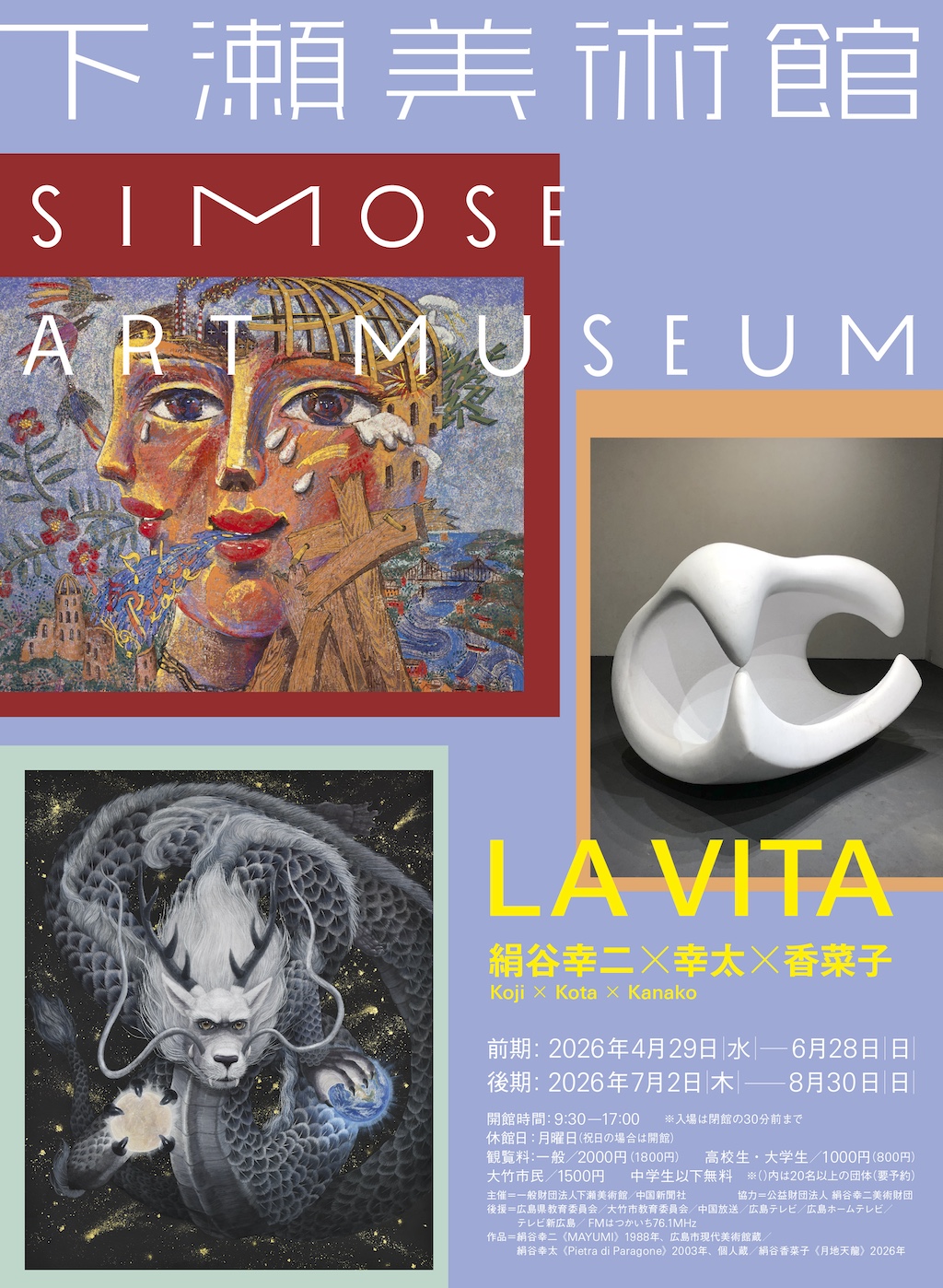
Koji Kinutani (1943-2025), a leading Western-style painter in the Japanese art world, his eldest son, sculptor Kota Kinutani (1973-), and his second daughter, Japanese-style painter Kanako Kinutani (1985-), are not only father and children, but have also cultivated three distinct styles in different fields: Western-style painting, sculpture, and Japanese-style painting.
Koji Kinutani was a leading figure in “affresco” (fresco painting), a classical technique of painting on plaster walls, and is known for his energetic style characterized by vibrant colors and innovative compositions. He also keenly observed contemporary social issues, conflicts, and wars, and continued to convey messages of global salvation and peace through his works.
Kota Kinutani creates abstract and dynamic sculptures using stones from around the world. Under the banner of “creative-perceptual sculpture,” which allows viewers to experience the artworks with all five senses, he conveys the timelessness of time and the richness of the Earth to viewers by engaging with the artwork not only visually but also with their whole bodies.
Kanako Kinutani has depicted various animals and mythical creatures such as dragons in a serene and fantastical style using delicate shades of ink. The lively animals, depicted with exceptional descriptive power, evoke a sense of tension in the viewer, as if they are gazing upon them, while simultaneously creating a viewing space for quietly confronting one’s own inner world.
This exhibition, the first joint exhibition of the Kinutani family (Koji Kinutani, his two children, and himself) since Koji Kinutani’s death, will feature the first public display of his final work, as well as new works created specifically for this exhibition. Bringing together the works of the three artists, tracing their rich creative trajectory and current position. Furthermore, the exhibition will include collaborations with works by Ryohei Koiso, and Matazo Kayama from the museum’s collection, and will also feature displays that utilize the characteristics of the architecture and landscape. We hope this project will help you rediscover the charm of our museum.
Finally, we would like to express our sincere gratitude to Mr. Kota Kinutani, Ms. Kanako Kinutani, Ms. Hiromi Kinutani, the Koji Kinutani Art Foundation, the museums and collectors who kindly agreed to exhibit their valuable works, and all those involved who contributed in various ways, for their tremendous cooperation in holding this exhibition.
April 2026
Simose Art Museum
Part 1-1 KINUTANI Koji’s World
Part 1-1 KINUTANI Koji’s World
Koji Kinutani was born in Nara City, in the Meishukan restaurant located on the shores of Sarusawa Pond near Kofuku-ji Temple. From a young age, he was familiar with Japanese culture and arts dating back to the mid-8th century, while also being exposed to the entertainment district where the restaurant was located and the people of various industries. He says that he learned “the importance of understanding two seemingly contradictory things, such as the sacred and the profane, and life and death, with ‘dual visions'” (Koji Kinutani, “Koji Kinutani Autobiography,” Nikkei Business Publications, 2016, p. 30). After entering Tokyo University of the Arts, he took “impermanence,” a concept from Japanese Buddhism, as his theme and expressed the way tangible things crumble in a unique style that is concrete yet indistinctly blends the outlines of things. Later, he studied in Italy and mastered “affresco” (fresco painting), a classical Western technique of painting on plaster walls. This led to the establishment of his colorful expression, which would later be called “Kinutani World.” Furthermore, his experience of the Italian environment further emphasized the contrasting elements that shaped him, such as Japan and the West, and modern painter and classical methods. He maintained throughout his life the philosophy he later expressed in the Buddhist term “Funi Hōmon” (non-duality), which states that “opposites are part of one.”
Born in 1943, in the midst of the Pacific War, Kinutani grew up witnessing firsthand the postwar landscape, including “U.S. Army going up and down the 52 stone steps below Kōfuku-ji Temple in a jeep, and Grumman fighter planes making sharp turns over Sarusawa Pond (ibid., p. 24).” From the early stages of his artistic career, Kinutani produced many works with war as a theme. As exemplified by his work “Yes or No” (I-10), Kinutani criticized, through his art, the discrimination and isolation created by wars and conflicts for all ages and in all places, or by divisions such as nationality, religion, culture, and gender, as tragedies caused by people trapped by the boundaries of “opposites” that are prevalent in society.
This section introduces the world of works of Koji Kinutani, who keenly observes the state of modern society and continues to pray for world salvation and peace, starting with “Portrait of Mr. Anselmo” (I-03), which earned him the Yasui Prize, a prestigious award for young painters, at the youngest age at the time.
KINUTANI Koji
KINUTANI Koji
Born in Nara in 1943. Kinutani formed an intimacy with his historic surrounds from his early age and cultivated a rich artistic sensibility.
After studying in the Oil Painting Department, Tokyo National University of Fine Art and Music, he went on to the Mural Painting Course in the university’s graduate school, where he encountered classic fresco painting techniques. He later went to study in the Academy of Fine Arts of Venice where he acquired the modern expression of the techniques of classical fresco mural painting and formed the idea of his striking, imaginary worlds. After returning to Japan, he established an innovative, dynamic style that garnered him several art awards. He has been at the forefront of the Japanese art world for more than 40 years.
In addition to being an educator, guiding the next generation at Tokyo University of the Arts and Osaka University of Arts, he created the “Koji Kinutani Prize” to support young, up-and-coming artists. In addition to being involved in the “Kids Dream/Art/Academy” sponsored by the Agency for Cultural Affairs, Kinutani keeps communicating the joy and fun in being creative to the next generation.
A member of Japan Art Academy.
Selected as a Person of Cultural Merit in 2014.
Awarded the NHK Broadcasting Culture Award of Japan Broadcasting Corporation in 2015.
Awarded the Order of Culture in 2021.
Part 1-2 KINUTANI Kota / Kanako’s World
Part 1-2 KINUTANI Kota / Kanako’s World
Kota Kinutani, is a sculptor, Koji ‘s eldest son, and his second daughter, Kanako Kinutani, is a Japanese-style painter. Both have established their own unique styles and are active in a wide range of fields, exhibiting their work in numerous exhibitions and art projects.
Kota Kinutani, who says, “When I confront the core of the stone, my heart is sculpted,” creates a viewing experience where viewers engage with the stone through all five senses, engaging in dialogue with the stone and reflecting on themselves. This stems from his own childhood experience in Italy, where he played with stone sculptures throughout the city during his father Koji’s work trips. In his creative process, he visits the sites where the stones he uses are collected and scientifically investigates their formation processes, capturing their properties from multiple perspectives and sublimating them into his works. This conveys the richness of the earth that nurtured the stones and the passage of time. At the same time, his works serve as a warning about the transience of humanity on Earth and the various problems surrounding modern society, such as environmental issues and wars caused by humankind.
Kanako Kinutani, with her exceptional descriptive skills, has depicted a wide range of subjects, from birds such as cranes to animals like wolves, bears, tigers, and zebras, as well as mythical creatures such as dragons and Qilin. Her depictions of animals are meticulously rendered, down to each individual strand of fur, scale, vein in their horns, and even the ray of light in their eyes, creating a serene tension as if they were gazing directly at the viewer. She states, “I choose to depict animals rather than humans because I want to project inner feelings onto them, regardless of external factors.” Unlike humans, who communicate through their gaze, animals are difficult to read. Through her depictions, viewers can project themselves onto the animals, creating a space for quietly confronting their own inner world.
This section focuses on the works of father and son, including collaborations with Koji Kinutani and their joint work, “Shining Life” (I-34), which explore themes of the Earth and a world where diverse life forms coexist. This exhibition will also showcase works by Kota Kinutani and Kanako Kinutani, including pieces created specifically for this exhibition, offering a glimpse into their creative process to date.
KINUTANI Kota
KINUTANI Kota
Born in Tokyo in 1973. Inspired to pursue sculpture after meeting sculptor Yoshitatsu Yanagihara.
Graduated from the Department of Fine Arts, College of Art, Sculpture Course, Nihon University in 1996, receiving the Dean’s Award.
Completed the Master’s Program in Sculpture at the Graduate School of Fine Arts, Tokyo University of the Arts in 1998.
Completed the Doctoral Program in Sculpture at the Graduate School of Fine Arts, Tokyo University of the Arts in 2002.
Completed graduate studies at the University of São Paulo in 2004.
In addition to creating numerous monuments both domestically and internationally, including the monument commemorating the 100th anniversary of Japanese immigration to Brazil in Carmo Park, São Paulo, Brazil in 2008, he also participates in art projects and artist-in-residence programs.
His main activities include the “Festival MANAZURU Sculpted Stones” (2019/Kanagawa Prefecture) and the “Artist-in-Residence – Nagi” (AIRN) (2022/Nagi Museum of Contemporary Art).
Notable exhibitions include “Kouta and Kanako Kinutani Two-Person Exhibition ~The Pulse of All Things~” (2022/Ikeda 20th Century Museum).
KINUTANI Kanako
KINUTANI Kanako
Born in Tokyo in 1985.
Graduated from Tama Art University, Department of Painting, Japanese Painting in 2007.
Completed the Master’s Program in Art Education at the Graduate School of Fine Arts, Tokyo University of the Arts in 2009.
Traveled to London in 2011 as an overseas research fellow of the Yoshino Gypsum Art Foundation.
Withdrew from the doctoral program in Art Education at the Graduate School of Fine Arts, Tokyo University of the Arts in 2013 after completing all required coursework.
In 2017, collaborated with Koji Kinutani on “Shining Life,” which was featured in a one-hour program on NHK BS Premium and NHK World.
Her major exhibitions include “CRAY-PAS ART by the Masters From Modern Japan to the Present Day” (2018/Sompo Japan Nipponkoa Museum of Art), “Tamabi DNA: The Genealogy of Contemporary Nihonga/ Japanese Paintings Since 1965” (2021/Tama Art University Museum of Art), and “Koji Kinutani & his children | Kota / Kanako” (2025/Kagoshima City Museum of Art).
Prayer for Peace
Prayer for Peace
Throughout his life, Koji Kinutani consistently criticized war and the unstable modern society. His works, including “MAYUMI” (I-15) and “Rabonya” (I-08), often feature figures with exposed heads and body skeletons, reminiscent of the Atomic Bomb Dome. These figures represent people battered and bruised by war and social unrest, and through their poignant forms, he conveys the message that such tragedies must never be repeated.
“Prayer for Peace,” as its title suggests, is his final and most powerful work, created to send a prayer for world peace from Hiroshima. This work does not feature motifs reminiscent of the Atomic Bomb Dome. Instead, it depicts the golden Hiroshima Castle, surrounded by two dragons and a fierce tiger facing off, with the majestic red Mount Fuji in the background. These elements unite in a swirling vortex of vibrant colors, creating an energetic and powerful work. For this exhibition, Kinutani chose not to depict Hiroshima as the tragic city where the atomic bomb was dropped, but rather as a city that has continued to move forward powerfully to this day, alongside its long history.
“I continue to paint “affresco” as if burying the events, dreams, hopes, sorrows, and hardships of his heart within the walls, as if his heart is staining the walls.”
(From “Kinutani Koji: A Journey of Color and Image” Catalog, Mainichi Shimbun, 2017, p. 91)
On the canvas, Kinutani Koji continues to engrave his wishes for a bright, hopeful future with his confident brushstrokes.
GUARDIAN
GUARDIAN
When we feel like giving up, or when we have something we want to protect, we seek something to rely on, don’t we? Inspired by the Twelve Heavenly Generals statues at Shin-Yakushi-ji Temple in Nara, I replaced human faces with animals to depict the essence of the act of “protecting.” I hope that this work will quietly evoke strength in viewers as they reflect on their own feelings.
Stop the Tank
Stop the Tank
This artwork was created in response to the war in Ukraine, expressing my anti-war sentiments. It was born from a desire to stop the tanks that were destroying homes and terrorizing people, and I created it while talking with my then four-year-old son about “making tanks into beings that bring happiness.” I depicted a bear as something that stops the tanks, entrusting it with the power and symbolism to overcome violence. I hope for an end to the conflict and for peace and happiness to return to the world.
The Movement of the Cloud 2
The Movement of the Cloud 2
In 2010, I visited Hiroshima and Nagasaki, and listened to many stories about the war from the Hiroshima Peace Memorial Museum and various people. Each event left a deep and lasting impact on my heart. At the same time, I remember feeling a sense of relief from the resilience of the people of Hiroshima, who, despite their immense grief, continued to live powerfully. With these feelings in mind, I created this work, reflecting on the atomic bombing of Hiroshima and imbued with a prayer for peace.
The golden clouds and white background in the center of the painting, when inverted, reveal the shape of the mushroom cloud that formed when the atomic bomb exploded.
I did not directly depict the atomic bomb or the war, but rather, within the negative space and forms, I conveyed the idea that history quietly breathes within our background. Present-day Hiroshima is so peaceful that it’s hard to believe an atomic bomb was dropped. While the memory is slowly fading over the approximately 80 years that have passed, I believe it is something we must never forget.
The left panel depicts the time before the atomic bombing.
The single crane gazing up at the sky and the three cranes flying in from afar represent the B-29 bombers. The faintly depicted mountain range in the background evokes the T-shaped Aioi Bridge, the target of the atomic bombing.
On the other hand, the right panel depicts Hiroshima’s “present” after the atomic bombing.
The horizon represents the vast land that seems to have lost everything, symbolizing the quiet continuation of time. Two red-crowned cranes, known for their lifelong mates, gaze at each other as they walk firmly on the ground. Their image reflects the strength of the people of Hiroshima who have continued to live each day to the fullest.
Furthermore, the depiction of the cranes’ legs being left white stems from the profound impact I felt when I saw the traces of the bombing at the Hiroshima Peace Memorial Museum—where only human shadows remained white, surrounded by charred remains. That fact remains deeply etched in my memory as something that must never be forgotten.
Through this painting, I hope that prayers for peace in Hiroshima, and for world peace, will quietly spread.
Sanctuary of Light
Sanctuary of Light
This work is based on “Dawn of Symphony,” which I painted in ink in 2014. At that time, I quietly expressed a light of peace and hope amidst the anxiety of the earthquake, but now, amidst ongoing wars and conflicts, I depict that light as something that truly exists in reality. Using color and gold leaf, I have imbued the image of diverse animals coexisting peacefully with harmony, prayer, and the wish for the Earth to become a place of rest.
Part 2-2 meets KOISO Ryohei
Part 2-2 meets KOISO Ryohei
In 1962, Koji Kinutani entered the Department of Painting (Oil Painting Major) at the Faculty of Fine Arts, Tokyo University of the Arts, where he studied oil painting. While he began seriously creating artwork from his junior high school days, submitting his works to public exhibitions, he also became devoted to the works of painters of the Independent Art Association, such as Kinosuke Ebihara (1904-1970), Takeshi Hayashi (1896-1975), and Seiji Chokai (1902-1972). In 1964, his third year at university, Takeshi Hayashi, whom he looked up to, left Tokyo University of the Arts, and since Kinutani was from the Kansai region, he joined the research laboratory of Ryohei Koiso (1903-1988), a painter from Hyogo Prefecture. Under the guidance of Koiso, who “accepted even completely opposite styles, whether abstract or contemporary” (from “Kinutani Koji: Autobiography,” Nikkei Business Publications, 2016, p. 50), Kinutani was able to dedicate himself to his art to his heart’s content. Later, when he himself taught at Tokyo University of the Arts, he spoke of his feelings towards Koiso, saying, “I would brainstorm ideas for my own works on the corners of papers distributed at meetings, (omitted) and honed my drawing skills by following the example of my teacher.” (ibid.)
During his university years, Kinutani was also passionate about diving. The sensations he experienced underwater, where he could float freely, sometimes even upside down, unlike on land, were sublimated into the philosophy he cherished throughout his life: not clinging to dualistic viewpoints, but viewing things from multiple perspectives.
Embracing the Light – Lucia –
Embracing the Light – Lucia –
This work depicts crows not merely as black, but as beings that embody a variety of colors through light. The black deepens through layering, expressing it as something that contains light and emotion. Through the allure of black that defies fixed impressions, I attempted to convey a quiet, certain light and presence residing within.
A little further beyond the world we think we see.
Beyond Their Eyes
Beyond Their Eyes
Based on the “Beyond the Horizon” series, which I’ve previously painted in sizes 10 to 20, this large-scale 120-size painting re-examines the thoughts residing in the eyes. Animals are less influenced by external factors and are beings that allow us to project our inner selves; their black eyes prompt the viewer to become aware of their inner selves. By reflecting one’s own thoughts into the abyss beyond the beauty of their outward appearance, and through the reversal of the relationship between seer and seen, the painting quietly brings to light the inner heart of the viewer.